


Lyman Fellowship Report: Meg Everett and Eda Er
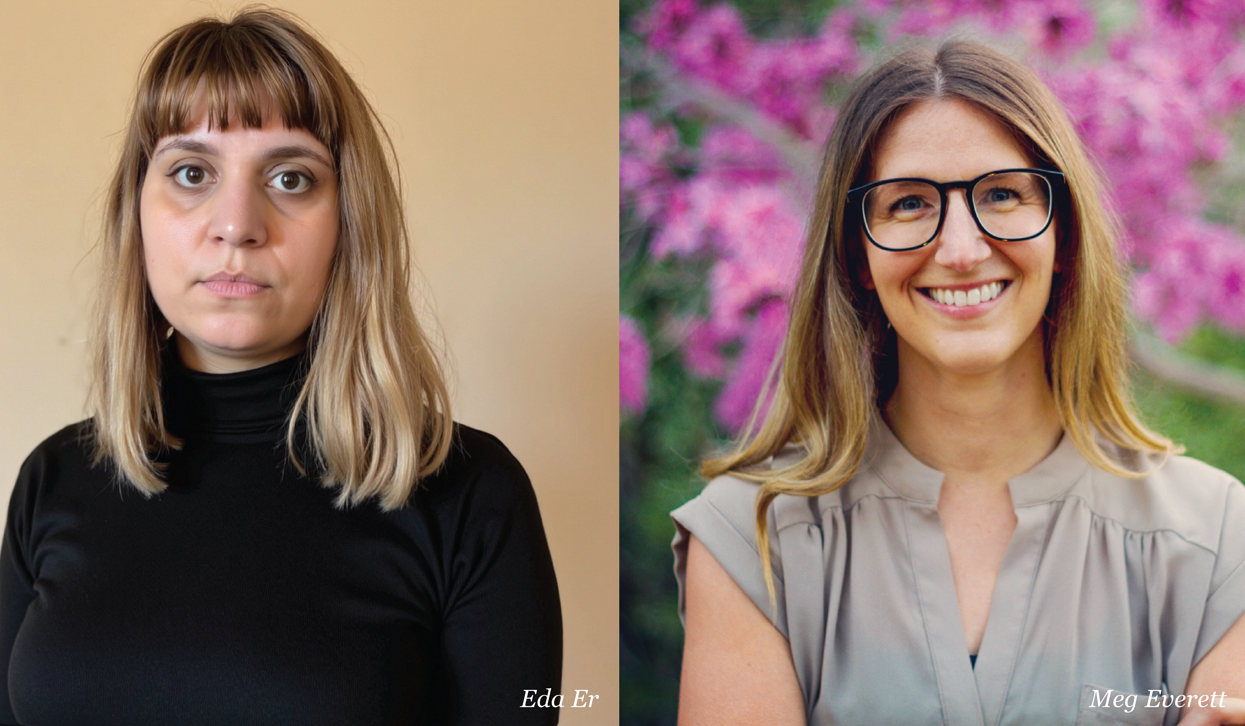
Our 2025 Lyman Fellows Eda Er (Ph.D. candidate in Music Composition) and Meg Everett (Ph.D. candidate in the Learning Sciences and Human Development) report on how their fellowships have enabled them to progress in their research.
The Peter Lyman Graduate Fellowship in New Media, established in the memory of esteemed UC Berkeley Professor Peter Lyman, provides a stipend to a UC Berkeley PhD candidate to support the writing of their PhD dissertation on a topic related to new media. The fellowship is supported by donations from Professor Barrie Thorne, Sage Publications, and many individual friends and faculty.
Eda Er
The Lyman Fellowship provided essential support during Summer 2025, enabling concentrated research and artistic development for my doctoral project, Fluid Narratives: Transforming Ebru Art into Sonic Composition through Feminist Storytelling and New Media. This period marked a critical phase in the expansion of my Ebru-based performance instrument and the refinement of its technical and conceptual framework.
During the summer, I focused on advancing the integration of traditional Turkish Ebru (marbling) techniques with interactive sound systems. Fellowship support allowed me to dedicate uninterrupted time to experimentation with hydrophones, contact microphones, light-based visual capture, and gesture-responsive mapping in Max/MSP. A key breakthrough was achieving more stable and expressive mappings between physical gesture and sonic output—for example, calibrating how variations in pigment density and the speed of water movement could reliably drive granular and physical modeling synthesis parameters. These refinements transformed the instrument from an experimental prototype into a more coherent compositional tool and performative interface.
This technical work required iterative prototyping and system testing, including the acquisition of specialized Ebru materials and sensor components for live processing. Through repeated cycles of building, testing, and refining, I established the reliability necessary for performance contexts—ensuring that the instrument could respond consistently to the unpredictable behavior of water and pigment in real time.
In parallel, I advanced the compositional structure of new movements for The Mother of Oceans, a large-scale multimedia work at the center of my dissertation. I refined score materials and formal architecture, working in particular on the integration of live electronics within ensemble textures—developing notation strategies that allow performers to interact with the Ebru instrument’s sonic output in flexible, responsive ways. The summer period also allowed me to consolidate the technical chapter of my dissertation, articulating the relationship between craft tradition, feminist theory, and interactive media systems.
The Lyman Fellowship provided not only financial assistance but the rare and invaluable gift of sustained focus. The progress achieved during Summer 2025—technically, compositionally, and intellectually—laid the groundwork for upcoming performances, international collaborations, and the completion of my dissertation. I am deeply grateful for the support, which has had a lasting impact on both my artistic practice and scholarly development.
Meg Everett
I am excited and grateful to report on how the Lyman Fellowship has supported my dissertation work and professional development over the past year. My dissertation, “The Intersection of Social Media and Schools,” investigates how social media platforms shape schooling experiences through a trio of qualitative studies that explore how teachers, students, and researchers navigate, make meaning, and exercise agency within an increasingly platform-mediated society. Rather than treating social media as simply beneficial, harmful, or incompatible with formal education, my work illuminates the contradictory ways platform dynamics already shape educational life, and identifies possibilities for more empowering engagement. With the support of the fellowship, I was able to complete two of these qualitative studies, present their findings at different conferences, and even translate my work directly into where it matters the most - schools.
As a Lyman fellow, I applied and was accepted to present the findings from my first qualitative study, “"My teachers would never talk to me about this. I'm glad that you do": TikTok Teachers Reflect on Classroom Conversations” at the Literacy Research Association Conference. This process provided me with valuable feedback from reviewers, which I used to sharpen my research questions. At the conference, I shared how these interviews revealed the ways that teachers leveraged their status on TikTok to build relationships with students, how their popularity on social media shaped the conversations they shared with students, and how they navigated complex boundaries between their online and offline identities. Upon my return, I completed this chapter and received feedback from committee members.
The fellowship also provided the space and time to hone the argument of my second study, “"Paying Attention to Where I Pay Attention": Developing Social Media Literacies through Reflection and Research.” With the support from the fellowship, I was able to have the time to take a wide and interdisciplinary approach to furthering my knowledge on the developmental and educational opportunities afforded by young adulthood. This study explores how formal classroom settings can leverage assignments that privilege self-reflection to support young adults in constructing intentional, values-informed relationships with the media environments that have shaped them since childhood. I completed this study, received feedback from committee members, and shared the insights of this work at the National Association of Media Literacy Education’s annual summer gathering.
In sum, with the support of the Lyman Fellowship I have been able to complete and receive feedback on two of my dissertation chapters and make significant progress in the writing of my third study, “"No Results Found": Platform Architectures and School Visibility on TikTok.” While allowing me to engage with researchers and practitioners through formal conference settings, the Lyman fellowship also positioned me to engage with and translate my research to community members through a PTA presentation at a local East Bay middle school. Speaking directly with parents was a reminder of why this research matters beyond academic audiences. As a scholar and educator committed to supporting youth digital well-being, the fellowship has put me on a clear professional path towards graduation where I will be able to continue this work in a variety of settings. The Berkeley Center for New Media’s commitment to open, multidisciplinary inquiry has been instrumental in shaping not just my research but my identity as a scholar. I am grateful for this community, the resources, and the legacy of Peter Lyman that made this year possible.